How kashikiri private baths work: booking, time slots and fees
A kashikiri bath (貸切風呂, also called a family bath or kazoku-buro) is a hot-spring bath that one group uses at a time behind a locked door. It is the most affordable way to get a private onsen in Japan, and it is how most couples, families and tattooed travellers bathe together at a ryokan. This guide explains how the system works, from booking a slot to what to do when the door is locked.
What is a kashikiri bath in Japan?
A kashikiri bath (貸切風呂) is a hot-spring bath that one group locks and uses alone for a set time, often 40 to 60 minutes. Many ryokan offer them free or for a fee, booked by time slot or first come, first served. They suit couples, families and guests with tattoos.
Updated · How we verify · Open data
What is a kashikiri bath?
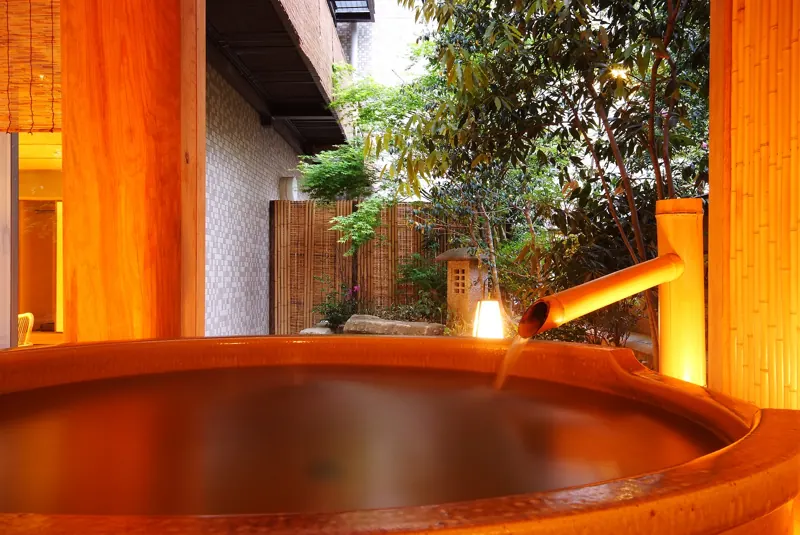
Kashikiri literally means 'reserved' or 'chartered'. At a ryokan or onsen hotel, it refers to a bath that is normally shared by guests in turns, but used by only one party at a time. Inside you will find a small changing area, a washing area with a stool, shower and basin, and a tub filled with hot-spring water. Some are indoor, some are open-air (rotenburo), and a few combine both.
The names vary. You will see 貸切風呂 (kashikiri-buro), 貸切露天風呂 (private open-air bath), 家族風呂 (kazoku-buro, family bath) and sometimes 'private spa' on English websites. They all describe the same idea, but rules differ by property, so read the details rather than relying on the label.
Kashikiri bath vs a room with its own bath
A room with its own open-air bath (露天風呂付客室) is yours for the whole stay. A kashikiri bath is shared over the day, so you use it for a slot. The kashikiri option usually costs far less, because you pay for a standard room. Our guide to the terms compares the options in detail.
The three ways inns run private baths
Every property sets its own system, but nearly all fall into one of three patterns. Our listings record which one each official website describes.
| System | How it works | Good to know |
|---|---|---|
| Advance reservation | You book a time when you reserve the room, or by phone or email before you arrive. | Most predictable. Popular evening slots go first, so book early. |
| Booking at check-in | You choose a free slot at the front desk when you arrive. | Arrive early in the afternoon for the best choice of times. |
| First come, first served | If the bath is free you go in and lock the door; a sign or lamp shows it is in use. | No planning needed, but you may need to try again later at busy times. |
A few inns mix these, for example free first-come use plus bookable slots for a paid larger bath. When a website doesn't say, we mark booking as 'not stated', and it is worth asking.
Time slots: how long do you get?
Slots are commonly 40 to 60 minutes, sometimes 30 minutes at busy inns, and occasionally longer for paid baths. The slot includes undressing, washing and dressing again, so plan on about half of it in the water. Hot-spring water is often 40 to 43°C, and many people find 10 to 15 minutes of soaking at a time is plenty.
Respect the end time. The next group may be waiting, and staff often need a few minutes to check the bath. If you are first-come and nobody is waiting, some inns allow you to stay longer, but don't assume so.
Free or paid: what private baths cost
Many small ryokan include private baths in the room rate. Others charge per slot, often a few thousand yen, and sometimes more for the largest or best-view bath. Some properties sell 'plans' that include a private bath, which can look like a high fee on the website but is really a package price. Check what the fee covers: per slot, per room or per person, and whether the hot-spring tax is separate.
Private baths in our verified data
Of the 219 properties we have verified, 188 have private kashikiri baths. 32 say they are free for guests and 39 charge a fee, with stated fees from ¥1,000 to ¥5,500 per use. For booking, 36 take advance reservations, 10 book at check-in and 20 are first-come; the rest don't say. Towns with the most free private baths: Kinosaki (11), Kusatsu (5), West Izu (3), Atami (2) and Shuzenji (2).
| In our verified data | Properties | Examples |
|---|---|---|
| Private kashikiri baths | 188 | Hakone Kowaki Sono Tenyu, La Vista Kusatsu Hills and Odakyu Hotel Hatsuhana |
| Free for guests | 32 | La Vista Kusatsu Hills, Hotel New Ohruri and Kikuya |
| Paid | 39 | Gekko Sono Yu Gassanso, Hotel New Sagami-ya and Koro-kan |
| Advance reservation | 36 | Hakone Kowaki Sono Tenyu, Odakyu Hotel Hatsuhana and Umi no Hotel Isaba |
| Book at check-in | 10 | Mikuniya, Naraya and Nogamihonkan Ryokan |
| First come, first served | 20 | Azumaya, La Vista Fujikawaguchiko and Hotel New Sagami-ya |
| Most private baths | 3 | Onsen Tenseien (12), Hakone Kowaki Sono Tenyu (8) and Gero Onsen Yamagataya (7) |
Counts from each property's official website, last checked 18 October 2026.
How to book a kashikiri bath step by step
- Check the property page here: we show whether private baths exist, how many, whether they are free, and how booking works, with links to the official source.
- If booking is in advance, reserve the slot when you book the room, or email the inn with your preferred times. Our step-by-step kashikiri booking guide has phrases and an email template.
- If booking is at check-in, arrive early and ask for a slot before dinner or late in the evening.
- If it is first-come, look for the sign or lamp outside the door; when the bath is free, flip the sign, lock the door and enjoy.
- After your slot, unlock the door, return any key or sign, and leave the bath tidy.
Rules inside the private bath
Private doesn't mean anything goes. The usual onsen etiquette still applies: wash and rinse before getting in, keep towels out of the water, tie up long hair, don't use soap in the tub, and leave the stools and basins neat. Drinking alcohol before a hot bath is risky, and many inns ask you not to bring drinks in. Read our onsen etiquette guide for first-timers if you are new to this.
Children, tattoos and couples
Private baths are designed for families and couples, so they solve the mixed-gender problem of shared baths. They are also the most reliable option for guests with tattoos, though a few inns apply their tattoo rule to private baths too. See onsen with tattoos and onsen with kids.
Common kashikiri problems and how to handle them
The bath is always occupied
At first-come inns, the busiest time is right before and after dinner. Try during dinner service if your meal time is early or late, after 9 pm, or before breakfast. Early morning is often the quietest and the light is lovely in open-air baths. If the inn has a lamp or sign system, check from your room's corridor rather than waiting by the door.
Your slot clashes with dinner
Ryokan dinners are served at set times and often take an hour or more. When you book a slot at check-in, ask for one that leaves at least 15 minutes before dinner, or book a slot afterwards. Most inns are relaxed about you arriving at dinner in the yukata they provide.
The water is too hot
Some sources run very hot. Many private baths have a cold-water tap or a wooden board for stirring. Adding cold water is usually fine in a private bath, but check any notice on the wall first, since some inns ask guests not to dilute a free-flowing spring. Get out and cool down if you feel dizzy.
Language barriers
Front-desk staff are used to explaining the system with a printed sheet or a map. Pointing at the bath on the floor plan and asking 'kashikiri?' usually works. Signs on the door often read 空き (free) or 使用中 (in use).
What to bring to a kashikiri bath
- Towels: the inn usually provides a small and a large towel in your room; bring both.
- Yukata and slippers for the walk there; take the room key.
- Hair ties and any toiletries you prefer, though most private baths provide shampoo and soap.
- Water for afterwards; you will be thirsty.
- Nothing glass: bottles can break on stone floors, and many inns ban drinks inside.
How to find the best ryokan for private baths
- More baths means more choice: an inn with three or more private baths rarely leaves you waiting.
- Free plus first-come is the most relaxed combination for a short stay.
- Open-air private baths are worth seeking out in snowy areas and towns with views.
- Check the water: some private baths use free-flowing spring water (kakenagashi), others treated or heated water.
Our collections help: ryokan with free private baths in Kinosaki, free private baths in Kusatsu, Hakone ryokan for couples, or browse every onsen town.
Related guides
Find a private onsen
Frequently asked questions
What does kashikiri mean?
It means 'reserved' or 'chartered'. A kashikiri bath is used by one group at a time behind a locked door.
Is a kashikiri bath the same as a family bath?
Usually yes. 家族風呂 (family bath) and 貸切風呂 (kashikiri bath) describe the same type of private bath, though rules vary by inn.
How long is a kashikiri slot?
Commonly 40 to 60 minutes, including time to change.
Are kashikiri baths free?
At many small ryokan they are free for staying guests; others charge per slot. Our listings show what each website states.
Do I need to book a kashikiri bath?
It depends: some inns take advance reservations, some book at check-in, and some are first-come, first-served.
Can couples use a kashikiri bath together?
Yes. That is one of the main reasons they exist, since shared baths are separated by gender.